
Sign In or Use Email

Youssef Aboul-Enein

Member of The Honor Society of Phi Kappa Phi
From Gaithersburg, Maryland
Youssef leverages over 30 years of military as well as civilian national security and intelligence experience teaching and advising the US military and various federal agencies. He takes great pride in shaping Americas future intelligence analysts and military leaders. Youssef is a Certified Defense Intelligence Agency (DIA) Intelligence Instructor, Middle East Subject Matter Expert, author, and co-author of seven books, most notably Militant Islamist Ideology: Understanding the Global Threat, and Middle East 101: A Beginners Guide for Deployers, Travelers and Concerned Citizens. His first book, published in 2010, went paperback in 2013 and was ranked among the top 150 most influential books on terrorism by the peer-reviewed journal, Perspectives on Terrorism. His 2019 book, answers 101 essential questions on the Mid-East for those wanting to begin a serious study of the region and was adopted by the U.S. Naval Academy. The book was listed in the Military Officers Association of America (MOAA) Magazines essential Summer 2020 reading for military professionals.

University of Arkansas at Little Rock
Hood College
University of Mississippi
Manarat Al Riyadh Schools

Youssef Aboul-Enein Elected to Membership into The Honor Society of Phi Kappa Phi

Youssef Aboul-Enein of Gaithersburg, Maryland, was recently elected to membership into The Honor Society of Phi Kappa Phi, the nation's oldest and most selective all-discipline collegiate honor so...

January, 16 2025 - Verified by The Honor Society of Phi Kappa Phi
Youssef Aboul-Enein was recognized for graduating
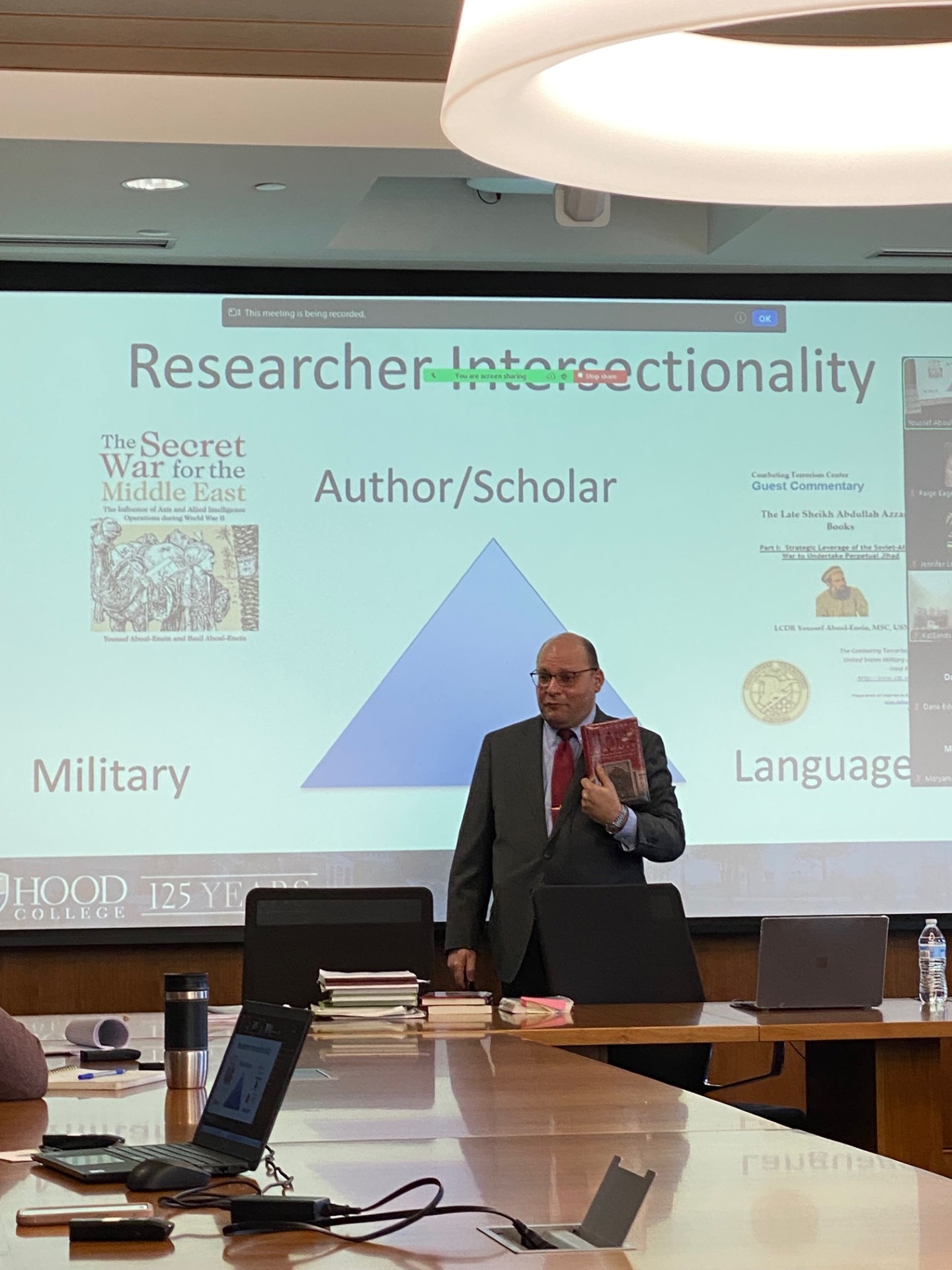
Youssef earned his Doctorate in Organization Leadership (DOL) from Hood College, his dissertation focused on analyzing the ideas of an Iraqi general who trained many of Saddam Husseins military officers.
Spring 2021 - Spring 2025 - Added by Youssef
Youssef Aboul-Enein was recognized for graduating
Graduated High School
Added by Youssef
Youssef Aboul-Enein was recognized for graduating
Graduated with a dual Masters in Business and Health Services Administration.
Added by Youssef
Youssef Aboul-Enein was recognized for earning a spot on the Dean's List
Added by Youssef
Youssef Aboul-Enein was recognized for earning a spot on the Dean's List
Graduated with Bachelors in Business Administration
Added by Youssef
Commander at US Navy (Ret)

Youssef served as Country Director for North Africa and Egypt, Assistant Country Director for the Arabian Gulf, and Special Advisor on Islamist Militancy at the Office of the Secretary of Defense for Policy from 2002 to 2006. He advised the Deputy Assistant Secretary to the Secretary of Defense on matters involving US defense policy towards the Middle East. From 2006 until his active-duty retirement in 2022, Youssef was Senior Counter-Terrorism Advisor and Subject Matter Expert on Militant Islamist Ideologies at DIAs Defense Combating Terrorism Center (DCTC). At DCTC, he advised on an array of Counter-Terrorism intelligence products up to the Presidential Daily Brief, prepared congressional testimony, and served as an expert government witness in various trials, most notably in the courts martial trial United States v. PFC Bradley Manning. Youssef provided linguistic support to the President of the United States and Chairman of the Joint Chiefs of Staff in 2014 meetings that gave rise to Operation Inherent Resolve, the counter-ISIS coalition. He has advised interagency government attorneys prosecuting Guantanamo detainees.

January 1994 - January 2022
Applying Social Community Identity and Spatial Theory to Extend Our Understanding of Ala al-Din Khammas: The Warrior-Scholar Who Trained Saddam Hussein’s Military Leaders
Ala’ al-Din Khammas is unique among Saddam Hussein’s generals interviewed in 2009 by U.S. military officials for his prolific publications produced while in Iraq’s military and after his retirement. His military manuals developed during the Iran-Iraq War (1980-1988) and distributed to Iraq’s field commanders, would be instrumental in stabilizing the southern Basra front. Khammas’ is also rare among Saddam’s officers for his effort to introduce American military works to Iraqi military officers. This study investigates Khammas’ intellectual imprint on Iraqi officers that would later confront American forces in Operations Desert Storm and Iraqi Freedom. This qualitative interpretive study critically examines Khammas’ magnum opus, The Arab Art of War (1999) which argues that Arabs have their own distinct art of war worthy of careful study developed in the 7th century. It experiments with identity and spatial relationship theories of Anderson (2016), and Tuan (1990) as frameworks in a novel approach to military analysis and expands our understanding of Khammas himself and his argument of a distinct Arab art of war. Applying these theoretical frameworks make up for Khammas intense focus on battlefield tactics and identifies two overarching principles embedded throughout his work, the use of extreme contrasts in terrain and how a changing Arab identity enabled a 7th century hybrid combination of tribal and conventional war that can be called a distinct all-encompassing Arab art of war.
March 2025 - Publications
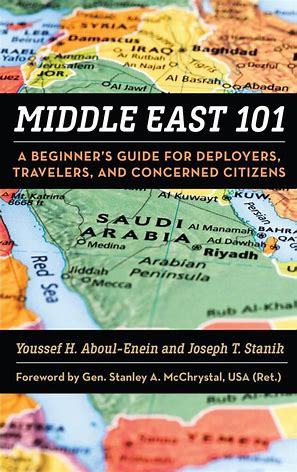
Middle East 101: A Beginner's Guide for Deployers, Travelers, and Concerned Citizens
This work answers 101 essential questions on the Middle East, Islam, the Arab Spring, al-Qa’ida, and ISIS. It is for those wanting to begin an intellectual immersion into the complexities of the region from pre-biblical times to the post-Arab Spring. The authors have carefully focused on what the deploying soldier, sailor, Marine, coast guardsman or airman needs to know before arriving in the Middle East, including the nuances inherent in a region that is the crossroads of three continents (Europe, Asia, and Africa) and how previous global powers interacted and left their mark. While developed and written for Americans about to deploy to combat zones and areas of operation, it is also of use to a wider audience of Americans serious about the challenges of the region.
May 2019 - Publications
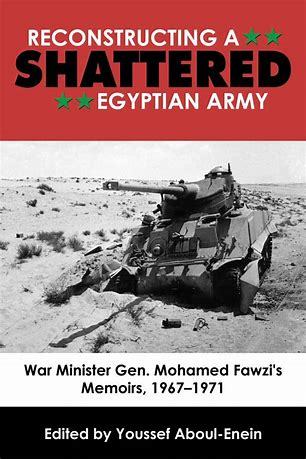
Reconstructing a Shattered Egyptian Army: War Minister Gen. Mohamed Fawzi's Memoirs, 1967-1971
Central to CDR Youssef Aboul-Enein's career has been the mission to introduce America's military leaders to Arabic works of military significance. Just like American military leaders who had an obsession for all things Russian during the Cold War in order to understand the Soviets, the war on al-Qaida and the complex nuances of the Arab Spring demand a deeper comprehension of the Middle East from direct sources. The memoirs of General Mohamed Fawzi, Egyptian War Minister from 1967 to 1971, were first published in 1984, but his work has not ben translated and remains undiscovered by English speaking readers. Many in the United States Armed Services have yet to be introduced to his ideas, perspectives, and the seeds by which the 1973 Yom-Kippur War were laid. In this new contribution to his series of essays written for Infantry Journal, Aboul-Enein has determined to bring to life the military thoughts of this Arab War Minister. This book is a joint Infantry-Naval Institute Press project that has condensed the entire collection of essays on Fawzi to a single volume, to provide future generations of America’s military leaders with access his ideas. Fawzi is unique among Arab generals for his scathing critique of his own armed forces, and from his critical examination of what went wrong in 1967, he was able to slowly resurrect the Egyptian Armed Forces to a level that enabled Sadat to consider an offensive in 1973. This Egyptian general will provide insights into the level of Soviet cooperation and military aid provided Egypt after the 1967 Six-Day War, known simply in Arabic by one word, al-Naksah (the setback), not to be confused with the 1948 Arab-Israeli War known by one word, al-Nakbah (the catastrophe). While Fawzi lapses into conspiracy, indulges in wishful thinking, and employs the language of pan-Arabism on occasion, much like Soviet military theorists couched their ideas in Marxist-Leninist rhetoric, this will not stop serious American students of war from recognizing his brilliance about the lessons learned from the crushing defeat of Egyptian arms in the 1967 Six-Day War.
June 2014 - Publications
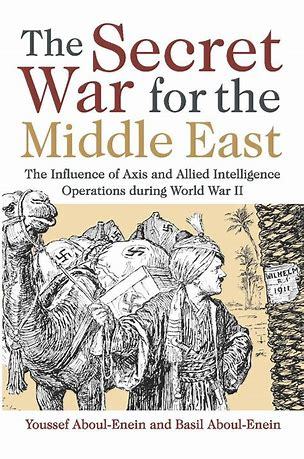
The Secret War for the Middle East: The Influence of Axis and Allied Intelligence Operations During World War II
It can be argued that the Middle East during the World War II has been regarded as that conflict’s most overlooked theater of operations. Though the threat of direct Axis invasion never materialized beyond the Egyptian Western Desert with Rommel’s Afrika Korps, this did not limit the Axis from probing the Middle East and cultivating potential collaborators and sympathizers. These actions left an indelible mark in the socio-political evolution of the modern states of the Middle East. This book explores the infusion of the political language of anti-Semitism, nationalism, fascism, and Marxism that were among the ideological byproducts of Axis and Allied intervention in the Arab world. The status of British-dominated Middle East was tailor-made for exploitation by Axis intelligence and propaganda. German and Italian intelligence efforts fueled anti-British resentments; their influence shaped the course of Arab nationalist sentiments throughout the Middle East. A relevant parallel to the pan-Arab cause was Hitler’s attempt to bring ethnic Germans into the fold of a greater German state. In theory, as the Sudeten German stood on par with the Carpathian German, so too, according to doctrinal theory, did the Yemeni stand in union with the Syrian in the imagination of those espousing pan-Arabism. As historic evidence demonstrates, this very commonality proved to be a major factor in the development of relations between Arab and Fascist leaders. The Arab nationalist movement amounted to nothing more than a shapeless, fragmented, counter position to British imperialism, imported to the Arab East via Berlin for Nazi aspirations.
October 2013 - Publications
Iraq in Turmoil: Historical Perspectives of Dr. Ali al-Wardi, From the Ottoman Empire to King Feisa
Naval Institute Press and the United States Army Journal, Armor is pleased to offer a unique collection of essays highlighting Iraq’s social, political and military history from a purely Iraqi perspective. Dr. Ali al-Wardi (1913-1995) attended the American University of Beirut in 1943 and then traveled to the United States to attain his Masters and Doctorate degrees in Sociology at the University of Texas in 1948 and 1950 respectively. He would return to Iraq and spend a career teaching, however his main legacy is a multi-volume work in Arabic that began to be published in late 1951 and ended in the early 1970s with his eighth book. It is a two decade work that highlights the history of Iraq from the arrival of the Ottomans to the monarchy of King Feisal I in 1925. Wardi’s volumes are read by a wide variety of Iraqi society, and this volume is an introduction to this pivotal Arabic work to English readers. It brings alive how the Ottomans, British and Safavid Persians dealt with sectarianism in Iraq and the battles fought over key areas of Iraq. It is required reading for those with an interest in or who are deploying to Iraq. Wardi's work also discusses the dynamics of the 1920 Revolt, a year long insurgency against the British that was only satisified when London engineered a political solution to its advantage. That solution became the imposition of a monarchy under King Feisal of Iraq, who was not Iraqi. The monarchy would topple in 1958 and see the rise of Baathism
April 2012 - Publications
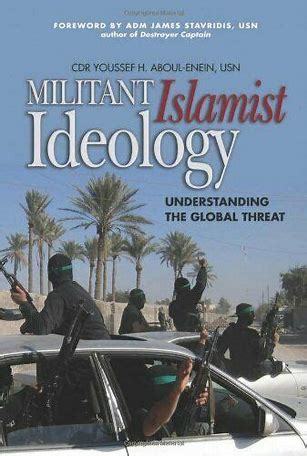
Militant Islamist Ideology: Understanding the Global Threat
This book proposes a common framework and definition of "Militant Islamist Ideology" to be considered by all ranks within the U.S. military. It seeks to define the differences between Islam, Islamist, and Militant Islamist, with the objective of disaggregating the immediate threat posed by Militant Islamist groups, and disaggregating them from Islamists and Islam. Winning this long war against militant Islamist ideology will require a higher level of nuanced understanding that will enable U.S. military personnel to comprehend that militant Islamists operate with the friction of diverse Islamic practices, nationalism, and tribalism inherent in the human landscape of the region.
May 2010 - Publications
AYMAN AL-ZAWAHIRI: The Ideologue of Modern Islamic Militancy
(THE US AIR WAR PRESS COUNTERPROLIFERATION PAPERS: Future Warfare Series, No. 21)
January 2004 - Publications
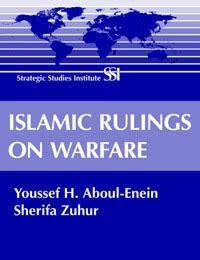
Islamic Rulings on Warfare
Army War College Press
January 2004 - Publications

Initiation

© Copyright 2026 • Merit Pages, Inc.Terms of ServicePrivacy Policy