
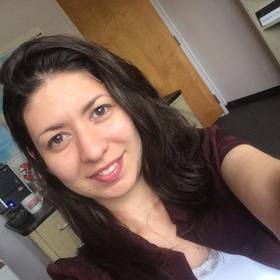
Marina Paula Carreira Rolim
Majored in Teaching English To Speakers Of Other Languages
Southeast Missouri State University, Class of 2016
From Cape Girardeau, Missouri
Southeast Missouri State University, Class of 2016
From Cape Girardeau, Missouri
Paula Rolim graduated from Universidade Federal do Para in Belem, Brazil, with a bachelor's degree in English and Literature. She graduated with an MA-TESOL degree from Southeast Missouri State University where she taught ESL for two years. She is currently pursuing a Masters degree in Professional Writing at the same university and teaches freshman English composition classes as a teaching assistant. Coming from the Amazon region, she is drawn to rivers and sunsets and enjoys long walks by the Mississippi river.
 Follow Marina Paula
Marina Paula Carreira Rolim Inducted into The Honor Society of Phi Kappa Phi
Marina Paula Carreira Rolim of Cape Girardeau, Missouri, was recently initiated into The Honor Society of Phi Kappa Phi, the nation's oldest and most selective all-discipline collegiate honor soci...
September, 20 2017 - Verified by The Honor Society of Phi Kappa Phi
Marina Paula Carreira Rolim Graduates from Southeast Missouri State University
Marina Paula Carreira Rolim of Belem, Brazil, is among Southeast Missouri State University's summer 2016 graduates. Carreira Rolim graduated with a Master of Arts with a major in TESOL.
October, 03 2016 - Verified by Southeast Missouri State University
Teaching Assistant at English Department SEMO
I teach freshman composition classes.
August 2017 - Present
ESL Instructor at Intensive English Language Program
I have worked as a tutor and as an ESL instructor at Southeast Missouri State University's Intensive English Program.
August 2014 - July 2017
Using Metacognitive Skills in ESL/EFL Classes to Promote Learner Autonomy
In order to have ELLs take responsibility for their own learning, it is important
that they develop skills to work their studies strategically. The less they rely on the
instructor as the content provider, the more they become active learners and have a
higher sense of self-regulation and confidence in the learning process. The teacher then
provides the learners metacognitive tools to foster their creative power of learning
outside the classroom. This paper investigates using metacognitive strategies as a
means to develop learner autonomy. As a result of this discussion, a new teacherstudent
relationship is proposed that encourages learners to reflect, think critically, and
act upon their realities. In this new paradigm, teachers take the role of a language
advisor and real educator providing students strategies that contribute to life-long
abilities.
Publications
Resume

